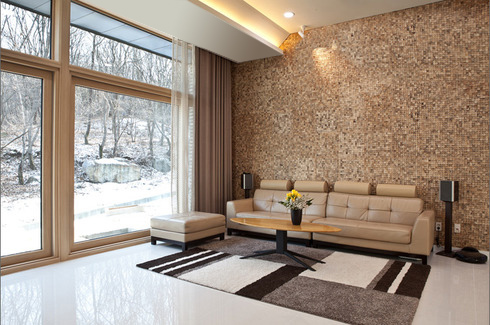
In cooling mode, capillary mats will generally be installed in ceilings or walls.

Wall radiant heating and cooling

Wall radiant heating and cooling

By using radiant heating and cooling walls with ultra-efficient capillaries, significant space and heat energy savings can be achieved.

When building these walls, there is no need for a massive mortar layer when plastering, as in classic heating and cooling walls, because the thickness of the capillary mats embedded in the mortar layer of the walls is 5 mm and the maximum thickness of the plaster is 1 cm.

The capillary systems operate with a maximum temperature of 37ºC for heating and 17ºC for cooling, with a temperature difference of 2ºC. Radiant walls with high efficiency (very low water content 0.3 litres/sqm) can be produced with very simple methods of execution.

The most important advantage of radiant heating and cooling walls with capillary mats, apart from the fact that there is no need for a thick layer of plaster (as with traditional wall heating), is the particularly fast reaction of the capillary heating and cooling walls.

The mass of the structure covering the capillary mats is much smaller than that of traditional wall heating systems, so the thermostat signals the actuator of the hydraulic heating circuit and in a few minutes the room is heated. With conventional, thick plaster systems, this system reaction can take several hours.

It is important to note that wall cooling can be achieved in particularly energy-efficient conditions by means of capillary mats. In addition to the very simple execution of the work, the system’s quick response, quietness and particularly comfortable working temperature (the temperature on the turn does not drop below 17ºC) ensure the user great comfort, in addition to the highest energy efficiency.

Another advantage of these applications is the dynamics of the shape. Basically, capillary mats can cover walls of any shape, flat, curved, cylindrical, corrugated, uneven, elliptical, etc.

In the case of attics with sloping walls, the capillary heating and cooling solution becomes the most efficient solution, in particular due to the particularly fast, simple and safe dehumidification as well as the small volume of water, the very thin plaster, the negligible static charges.

Please contact us for details!

This site is registered on wpml.org as a development site.