Tel: 0040 0266 321077 | Email: info@promax-engineering.com
High-tech central heating and cooling with parallel capillary pipe system
Modern man has a major influence on the microclimate in which he lives. However, this influence can only be exerted on the indoor climate in buildings.

Modern man has a major influence on the microclimate in which he lives. However, this influence can only be exerted on the indoor climate in buildings. From an environmental point of view, it is very important to reduce pollution of nature through recycling and reuse of raw materials, proper disposal of waste and reduction of energy losses. Energy is the decisive factor of the environment and of life.
Global warming has worrying consequences and is forcing us to pursue a policy of reducing energy consumption in all areas of activity. Energy consumption plays a major role not only in production and processing processes. The task for specialists is to find new technologies for reusing waste or disposing of it in an environmentally safe way.
The production of parallel capillary pipes uses polypropylene which comes from the reuse of specific production raw materials.

The modern form of comfort heating and cooling
In general, buildings are heated by conventional systems that transfer heat from radiators to the air volume of the rooms. In the case of cooling, the situation is identical. Instead of radiators, fan coils are used.
The components of conventional systems are partly located in rooms, such as radiators, convectors, ducts, etc. Thus, these components reduce the usable surfaces of rooms, and in some cases create aesthetic problems.
The disadvantages of these classical systems are the following-
- high energy consumption
- noisy operation (fan coil)
- high maintenance costs
- reducing the usable floor area of rooms
- air currents acting as dust
- current sensation
- costly electrical, sewage and thermal insulation work (on cooling systems).
Only some of the disadvantages that are eliminated by the use of parallel capillary pipe heating-cooling systems have been listed.
The comfort heating-cooling method consists of tempering the air in rooms, with heat transfer or cooling taking place through the walls or ceiling of the rooms.
The main role is played by parallel capillary pipes, through which the thermal or refrigerating agent reaches the building elements – walls, ceilings, floors.
The idea for the solution comes from the human body, where the thermal balance is provided by the skin. The human body must be kept at a constant temperature of around 37 degrees Celsius. For this purpose, the internal heat must be discharged to the environment.
Due to chemical reactions in the body, heat is produced, which is taken up by the blood and transported to the surface of the skin, from where it is removed to the outside by convection, radiation, conduction, etc. The feeling of thermal comfort is achieved when thermal equilibrium is established between the human and the environment, with the human body temperature being kept constant at its nominal value.
The thermal comfort of the human body is mostly provided by radiation.
Thermal balance of the human body
In cold outdoor temperatures, the body’s thermal balance can be maintained by appropriate clothing. At high temperatures, heat balance is provided by convection (30%), evaporation (20%) and radiation (50%).
The ideal balance of the human body is achieved when it can release about 50% of its excess heat energy through radiation.
Human body temperature is not uniform, so the head area is about 5K warmer than the feet area. Thus, the main heat transfer surface is in the upper part of the body.
Conclusions
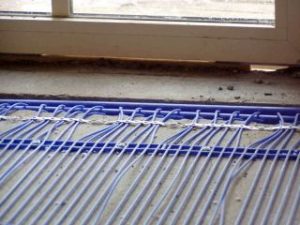
Humans spend most of their time in buildings, with rooms equipped with increasingly advanced facilities. The architect has an obligation to design functional and comfortable buildings, but the demands on the comfort level of buildings oblige the installation engineers to find and promote the most efficient solutions in the design of heating and cooling installations.
The heating-cooling systems with parallel capillary pipe system, presented below, meet the highest requirements of comfort, economy and all this at low investment costs.
Thus, in rooms equipped with the parallel capillary heating-cooling system, people feel comfortable, with a feeling of maximum comfort, both in the cold season and in summer, at uncomfortable outdoor temperatures. This is demonstrated both by the experiences of buildings equipped with the parallel capillary pipe system and by laboratory tests.
Capillary tube technique
From a physics point of view, the name capillary pipe is incorrect, because the capillary effect is negligible, but this construction material has spread around the world under this name, and the technical name has been retained to this day.
With this technique, radiation cooling with a symmetrical effect can be achieved, which has changed the negative theory about air conditioning in Europe.
In addition to the technical advantages, this form of silent heating and cooling, without producing draughts and ensuring a high degree of comfort – according to doctors – also increases the effectiveness of human activity.
In rooms equipped with this system:
- no sound of the plant operating
- there are no draughts
- no sweating
You only feel the presence of the system, the comfort it provides, and you can relax or concentrate on the work at hand.
The system meets the requirements of temperate climates. In the cooling mode, there is no sudden cooling effect, the person entering the cooled room does not feel cold draughts. Instead of negative effects, the heat given off by sunstroke, people, computers, machinery, lighting, etc. is slowly removed from the room.
To cool surfaces, the system uses water, a cheap thermal agent with ideal thermodynamic parameters for the purpose. This provides the user with drastic cost savings compared to air-only systems.
In the course of using the plant, savings of 50% are made from the elimination of air transport costs alone.
The economics of the system become even more apparent when you calculate the high energy consumption of air systems.
In parallel capillary pipe systems, due to water operation, energy consumption is reduced by 90%.
The use of water in the system means that the investor or beneficiary of the building equipped with this system will be able to make surprising savings in space. Compared to air ducts requiring large volume and disused surfaces, in a six-storey office building for example, thanks to parallel capillary pipe technology at identical internal heights, the building can be used as a seven-storey building.
This is made possible by reducing the size of air channels and freeing up large surfaces.
Effect of parallel capillary tube system on indoor room temperatures
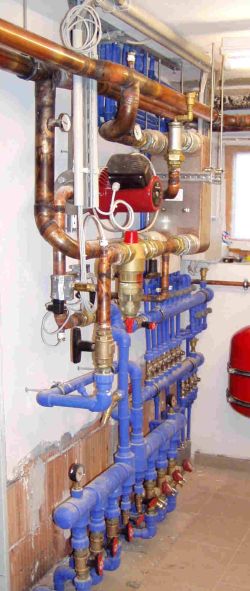
The degree of comfort between humans and the environment is largely influenced by the continuous exchange of energy. The energy exchange, however, depends on the ambient temperature:
- air speed
- surface temperature of rooms, assuming normal relative humidity.
In most cases in practice, energy exchange with the environment is achieved in three ways
- convection,
- evaporation,
- radiation.
- The people questioned during the laboratory experiments, entered as a unit of measurement – felt temperature. This temperature can be expressed as the arithmetic mean between the temperature of the air in the room and the temperature of the room’s boundary surfaces.
In cooling mode, the comfort temperature has increased by 2K without the use of a chilled ceiling, which brings significant energy savings.
In heating mode, the heated ceiling as a radiation surface has the following significant advantages compared to convection systems: radiation penetrates deep under the skin, into the clothing, with a positive effect on metabolism, the cardiovascular system, particularly the vascularity of the dermis, the respiratory system and the immune system. Man feels good, and the body is balanced (in terms of comfort and health).
In rooms – due to the effect of high surface area cool walls, there is a lack of dust and bacteria compared to radiator or fan coil systems.
- no draughts
- due to the thermal radiation effect, wall surfaces and furniture will have higher temperatures, which makes it possible to maintain interior temperatures of 20 grd C instead of 23-24 grd C compared to conventional systems.
The climate thus provided in the rooms is not only more pleasant and healthier, but also has significant environmental and economic advantages, making it possible to reduce the overall energy consumption of the system by approx. 20%.